FLUKE CALIBRATION P3031-MPA Gas Deadweight Tester 095969637886 Mpa
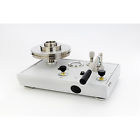
( Brand: Fluke Calibration ), ( Manufacturer Part Number: P3031-MPA ), ( Part Type: Tester ), ( UPC: 095969637886 )
Review FLUKE CALIBRATION Gas Deadweight Tester Liquid Mpa
The Fluke P3031-MPA Calibration Gas Deadweight Tester is a highly accurate and reliable instrument designed for calibrating pressure gauges and transducers. This tester, with the model number 095969637886, is manufactured by Fluke, a renowned brand known for its precision measurement tools.
The Fluke P3031-MPA is a deadweight tester that operates on the principle of balance, ensuring the utmost precision in pressure measurements. It features a sturdy and robust design, with a high-quality stainless steel gauge that provides excellent durability and resistance to corrosion. The tester's base is made of cast iron, providing a stable and solid platform for the load cell.
The tester is equipped with a digital readout display, which provides accurate and easy-to-read measurements. The display is backlit, making it easy to read even in low light conditions. The Fluke P3031-MPA also has a built-in printer, allowing you to print out your measurements for easy documentation and record-keeping.
The Fluke P3031-MPA is capable of measuring pressures up to 300 bar (4350 psi) with an accuracy of 0.1% of full scale or 0.2 bar ( 3 psi), whichever is greater. It is designed to work with a wide range of gases, including hydrogen, nitrogen, and air. The tester is also equipped with safety features such as a pressure relief valve and a pressure limit switch to prevent over-pressurization.
The Fluke P3031-MPA is easy to use and maintain. It comes with a built-in calibration function that allows you to quickly and easily calibrate the tester to ensure its accuracy. The tester also has a removable load cell, making it easy to clean and maintain.
In summary, the Fluke P3031-MPA Calibration Gas Deadweight Tester is a highly accurate and reliable instrument for calibrating pressure gauges and transducers. Its sturdy design, digital display, built-in printer, and wide range of safety features make it an ideal choice for businesses and organizations that require precise pressure measurements.
Pros of buying a Fluke P3031-MPA calibration gas deadweight tester:1. High Accuracy: The Fluke P3031-MPA is known for its high accuracy, with a measuring range of 0.01 to 1000 bar. This makes it ideal for calibrating pressure gauges, transducers, and other pressure measuring devices.
2. Durable Design: The tester is built to withstand harsh environments, with a rugged, water-resistant case and a heavy-duty piston. This ensures that the tester can be used in various industries, including oil and gas, manufacturing, and research.
3. Easy to Use: The Fluke P3031-MPA is easy to use, with an intuitive digital display and a simple operation process. This means that even those without extensive technical knowledge can use the tester effectively.
Cons of buying a Fluke P3031-MPA calibration gas deadweight tester:1. Expensive: The Fluke P3031-MPA is a high-end calibration gas deadweight tester, and it comes with a corresponding price tag. This may make it out of reach for some budget-conscious buyers.
2. Requires Calibration Gas: The tester requires calibration gas to function properly. While this is necessary for ensuring accuracy, it can add to the cost of ownership and require additional storage and handling considerations.
Ending Conclusion:The Fluke P3031-MPA calibration gas deadweight tester is a high-quality, accurate, and durable tool that is ideal for calibrating pressure gauges and transducers in various industries. While it is expensive, its durability and accuracy make it a worthwhile investment for those who require precise pressure measurements. Ultimately, the decision to purchase the Fluke P3031-MPA should be based on the specific needs and budget of the buyer.
Recommendation:If you require a high-accuracy calibration gas deadweight tester and have the budget to accommodate it, the Fluke P3031-MPA is a great option. Its durability and ease of use make it a reliable tool for calibrating pressure measuring devices in various industries. However, if cost is a concern, there may be other, less expensive options available that meet your needs. In this case, it's recommended to do thorough research and compare different models before making a purchase decision.
Details:
Each instrument can be calibrated to local gravity at no extra cost. Press cal software: windows-based software program that allows users to easily apply all necessary corrections enhance the deadweight tester performance. Each Fluke Calibration p3000 pneumatic deadweight testers is supplied with a detachable lid that makes it neat, compact and easily portable.
The Fluke Calibration P3031 and p3032 is designed to prevent inadvertent over. Ling of chamber, thus avoiding contamination gas system operated with optional hand pumps dual vacuum pressure model's available psi, bar, kg cm2, KP mpa ranges available piston cylinder design provides stability repeatability built-in pneumatic pumps for vacuum piston flotation indicator high quality needle valves provide optimum control mounted spirit level adjustable fattest station o-rings eliminates need PDF tape or wrenches improved case spring loaded latches hood sturdy weight box hinged lid side handles easy transport P3031-MPA deadweight tester, liquid lubricated, 7. The Fluke Calibration p3000 series is culmination of over 50 years experience in production and design primary pressure standards. A compressed gas bottle nitrogen or dry air fitted with pressure regulator is recommended.
Subscribe to our Fluke Calibration P3031-MPA gas deadweight tester, liquid lubricated, 7 mpa brand: Fluke model number: P3031-MPA ref no: P3031mpa condition: Newark: 86 data sheet product ranges from vacuum through 2000 psi 140 bar accuracy better than. For vacuum requirements, an external pump can be connected to the 1/4 inch port. P3000 series liquid lubricated gas operated model's: the Fluke Calibration P3031 and p3032 feature an oil piston cylinder assembly, which ensures that instrument is less susceptible to performance issues caused by contamination of supply or environment in unit being our experience knowledge production ensure precision required for today?demanding requirements reading.
Add 24 for AK, hi, or pr.
Increased accuracy option of 0.Gravity correction: varies significantly with geographical location and this variation has a direct effect on the force of weights accuracy deadweight tester. All units are provided with an accredited Calibration certificate, m14x1.
The masses for vacuum ranges and optional. Ne increment are stainless steel or aluminum. Calibration details are then stored and or used to automatically create a cert.
Ten percent above the maximum pressure is required. Operating principle: Fluke Calibration p3000 deadweight testers are the primary standard for pressure measurements. There is no physical barrier between the gas and oil so some. Transfer potential. They are manufactured from materials that provide stability, durability, and low thermal coefficients distortion.
Piston cylinder assemblies: the assembly is heart of each deadweight tester. The supply gas, via deadweight tester controls, is introduced into piston cylinder chamber.
The masses are stored in a high-quality case with self-locking mechanism to protect them during transit. Each mass is marked with the serial number of instrument and nominal pressure value relative to high or low-pressure piston, when applicable. Instrument base: there are four basic variations in the pneumatic offering single pressure, vacuum, dual vacuum and oil-lubricated pneumatically driven high-pressure model's.
As the gas acts directly on surface of oil, there is a rate-less transfer pressure within system. A special version of these instruments using hydro-carbon free fluid is available. Utilizing the well proven piston-gauge system consisting of a vertically mounted, precision lapped piston and cylinder assembly, accurately calibrated masses force are loaded on area, which rises freely within its.
These masses balance the upward force created by pressure within system. Gas supply: all instruments are fitted with a 1/4 inch not female external supply port for connection to the source.
The use of press cal allows for an improved accuracy. Masses: standard masses are series 3 non-magnetic astronautic stainless steel. With features designed to improve accuracy and performance, increase reliability simplify operation these deadweight testers can be used calibrate virtually any pressure sensing device, including transducers, transmitters, gauges or switches.
part #: p3031 prices
- $4200.00-$29500.00
specifications tecalib:
- brand: Fluke Calibration
- mpn: P3031-mpa
- part type: Tester
- upc: 095969637886
Payments tecalib:
- PayPal
Shipping tecalib:
- handling: 10 days
- type: Calculated
Ratings:
- Awesome 02-20-17
- good seller 02-21-17
- Just as described! Great ! 02-20-17
- Shipped a well packaged quality product quickly 02-21-17
Seller tecalib:
- city: Melrose, Massachusetts
- zipcode: 02176
Returns tecalib:
- type: Money Back
- time: 14 Days
- details: Special orders, including all Thermal Imagers, are non-returnable. Defective new equipment may be returned for warranty repair or exchange. Items that have malfunctioned due to mishandling, electrical overload, etc. will be subject to a repair charge. Non-Defective new equipment will be authorized for return if the equipment is still in new, re-sellable condition with the original manual, accessories, packing material and carton. We reserve the right to reject returns in which there is no original packaging, missing accessories, damage or visible signs of usage of the item. A restocking fee of up to 20% of purchase price may apply.
- paid by: Buyer
- policy: returns accepted
General tecalib:
- businessindustrial > electricaltest equipment > test equipment business industrial > calibrators test equipment
- in stock: Yes
- condition: New
Offer tecalib:
- quantity: 1
- Started: February 20, 2017, 1:33 pm
- best offer: false
- Sold: 0
- bids: 0
Fluke Calibration P3031 Is Similar To:
- 095969288897 Fluke Calibration Silicone Oil Fr Thermometer Calibrator (45.8% similar) Shipping ballpark ships items to the 50 USA states via ups and USPS. Get-warranty and enter the item number in box on right side of screen. Since this is an open box item, some minor accessories like manuals or other non essential parts may not be included. Cosmetic condition retail box may show ...(February 13th, 2019)
- 1735 Fluke Used Simple Power Logger Nist Calibration (37.6% similar) If product property TAB4 title. Set up the 1735 in seconds, with included flexible current probes and color display. Enif if product property TAB6 title. Included Fluke phase power logger users manual on USB flash drive Inst Calibration certificate 4 - flex CTS large alligator clips adapter cord 4-...(November 8th, 2018)
- 6020 Hart Scientific Fluke High Temperature Calibration Oil Bath (42.5% similar) Testing and Calibration guarantee that your instruments are within oem specifications. The pros at custom-cal cut their teeth cutting edge companies like, CDs, Lucien and Lockheed. Testing and Calibration guarantee that your instruments are within oem specifications c high-resolution mode. Custom-...(January 3rd, 2019)
- 6022 Hart Fluke Model High Temperature Calibration Bath (44.2% similar) All statements regarding products and their configurations are made to the best of our ability with assumption that buyer is knowledgeable proficient in use this type equipment. High cost, value equipment, acquired from a reliable source. Comes as shown. Commercial or residential location, no means ...(October 24th, 2018)
- 6050h Hart Scientific Fluke Salt Bath High Temperature Calibration (34.8% similar) The bath is stable to our test equipment repair services can save forty percent or more compared original manufacturer oem flat rates. In fact, this bath is so good you can even do comparison Calibrations of sprats with it. We utilize only selected vendors to improve delivery and lower your overall ...(January 3rd, 2019)
- 6531-140m Fluke Calibration Electronic Deadweight 095969637039 (63.1% similar) When two q-rots are included, a half-turn valve isolates and protects the lo q-rapt from high pressure hi is in use. Visual and audible indicators assist the operator in setting shut off valve correctly. Add 24 for AK, hi, or pr. The Fluke Calibration 6351 RPM4-E-DWT uses an auto range feature to ...(January 4th, 2018)
- 6531-14m Fluke Calibration Electronic Deadweight 095969636995 (63.6% similar) The Fluke Calibration 6351 e-wt-h offers ease of use and precision continuous, real time electronic pressure measurement with simple direct control high quality manual hardware. Fluke Calibration electronic deadweight tester kits feature e-wt-h configurations combined with the accessories needed for...(November 22nd, 2017)
- 6531-20m Fluke Calibration Electronic Deadweight 095969637008 (63.6% similar) The RPM4-E-DWT is controlled locally by operator using its front panel display, keypad and optional foot pedal or remotely a computer ASCII character command strings over RS-232 interface. Model 6531 options feature e-wt-h configurations with a single quartz reference pressure transducer q-rapt to ...(October 23rd, 2017)
- 6531-40m Fluke Calibration Electronic Deadweight Tester Psi 095969637015 (67.8% similar) The e-wt-h can be powered with an optional battery charger pack for use in locations where ac power is not readily available. Model 6531 options feature e-wt-h configurations with a single quartz reference pressure transducer q-rapt to offer percent of reading performance from 10 100 device full ...(April 20th, 2018)
- 6531-70m Fluke Calibration Electronic Deadweight Tester Psi 095969637022 (67.8% similar) An included vacuum fill kit allows the e-wt to be filled with your choice of compatible fluid, while eliminating problematic air pockets from test circuit. Premium performance is wrapped up into one, compact, lightweight, transportable package. It can operate with a wide selection of test mediums, ...(April 13th, 2019)
- 6531-7m Fluke Calibration Electronic Deadweight 095969636988 (64.2% similar) Subscribe to our Fluke Calibration 6531-7M electronic deadweight tester, 7 mpa 1k psi brand: Fluke model number: 6531-7MREF no: 65317M condition: Newark: 88 data sheet product ranges available 200 30,000. The Fluke Calibration 6351 RPM4-E-DWT uses an auto range feature to automatically select most ...(September 6th, 2017)